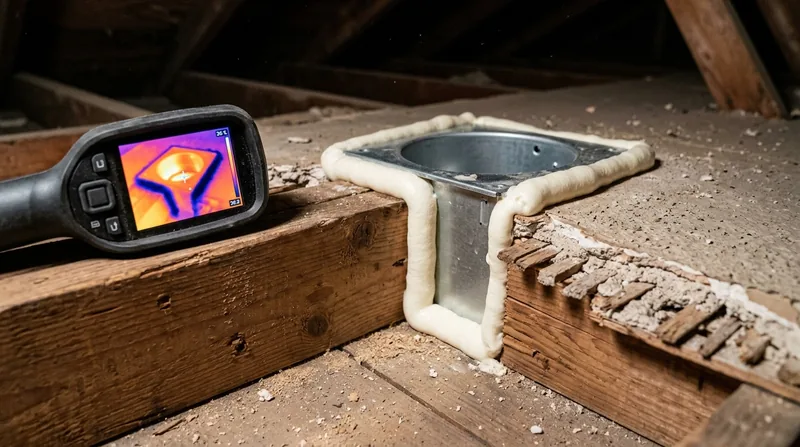




Air sealing in Kansas City stops the leaks that make heating and cooling work twice as hard. Top plates, can lights, chimney chases, and attic hatches pour conditioned air into the unconditioned space above, and that loss is invisible until you see the energy bill or feel the cold draft in winter. We seal those leaks before insulating, the step that makes every R-value actually perform and the cheapest comfort fix in a Kansas City house. Whether your home sits on a basement in Hyde Park or a block foundation in Raytown, the stack effect in winter and the vapor drive in humid summers demand that air leakage be stopped first. Read more about our attic spray foam insulation to see how sealing and insulation work together.
Why Air Sealing Matters in Kansas City Attics and Basements
Kansas City homes rise from basements on limestone and clay, and almost every attic bakes at 130 to 150 degrees Fahrenheit in July, then freezes in January. That temperature swing drives air pressure differences that push heated air up and out through the smallest gaps. A 1950s brick ranch in Gladstone, a 1920s shirtwaist in Midtown, or a 1990s two-story in Lee's Summit all face the same problem: unconditioned attic space directly above living space, connected by dozens of small leaks that standard blown-in insulation cannot seal. Air sealing stops the flow before it starts, and the payoff is immediate.
- Top plates where walls meet the attic floor leak heated air year-round and are the single largest source of attic air loss in Kansas City homes.
- Recessed can lights in ceilings create gaps around the fixture that pull warm air directly into the attic in winter.
- Chimney chases and furnace flues are framed with wood and drywall, and the seams shrink and separate as the house settles.
- Attic hatches and pull-down stairs are almost never weatherstripped and dump air every time they open.
- Rim joists and band joists where the rim beam sits on the basement wall are exposed to temperature swings and are common leak points in older homes.
Sealing these leaks before blown-in or spray foam insulation is applied ensures that the insulation actually stops heat transfer instead of just filling a space with leaking air underneath.
Key info: The Kansas City Building Code requires thermal barriers and ignition barriers on foam insulation, and attic ventilation rules vary by zip code. Always check with your local building department before sealing and insulating. See the Kansas City Building Department for permit and code requirements at your address.
How We Air Seal in Kansas City: A Step-by-Step Process
Air sealing is not a one-size-fit-all job. A 1960s ranch in Raytown with a flat attic floor needs different sealing than a 1930s Tudor in Waldo with knee walls and a finished half-story. We start with a walk-through to locate the leaks, then seal them with spray foam, caulk, or weatherstripping depending on the gap size and location. The goal is to stop air movement without trapping moisture, which means understanding the vapor drive that flips with the seasons in Kansas City's mixed-humid climate.
- We identify all air leaks by walking the attic, basement, or crawl space and marking gaps at top plates, can lights, chases, and rim joists.
- We seal large gaps (more than one-quarter inch) with closed cell or open cell spray foam, depending on the location and moisture risk.
- We caulk smaller seams and gaps that do not need foam, using low-VOC sealant that meets code.
- We weatherstrip or tape attic hatches, pull-down stairs, and access doors to stop air leakage when they are closed.
- We verify the seal with a visual inspection and note any areas where ventilation must remain open per code.
Once the leaks are sealed, we can insulate with spray foam or recommend blown-in if your attic is already sound and needs only a top-up. See our open cell spray foam page for the insulation options that work best with air sealing.
Real example: A Brookside bungalow from 1935 had a flat attic with original vermiculite insulation (left untouched), air leaking around the top plates where the brick walls meet the floor joists, and a can light fixture in the master bedroom ceiling pulling cold air into the attic in winter. We sealed the top plate with closed cell foam, sealed the can light with caulk and a trim ring, and left the vermiculite in place. The homeowner reported noticeably warmer bedrooms and no smell or moisture issues after the work.
Air Sealing Methods and When to Use Each
| Method | Description | Best for |
|---|---|---|
| Closed Cell Spray Foam | Two-part polyurethane foam that expands and hardens in place, creating an air and moisture barrier. | Top plates, rim joists, and areas where moisture control is critical or where the foam will be exposed to temperature swings. |
| Open Cell Spray Foam | Lower-density foam that seals air leaks but allows moisture vapor to pass through, reducing condensation risk. | Interior attic sealing in Kansas City's mixed-humid climate, where vapor drive flips with seasons and breathability is an asset. |
| Caulk and Sealant | Low-VOC polyurethane or silicone caulk applied to small seams, cracks, and gaps that do not need structural fill. | Sealing around can lights, electrical boxes, and small gaps in drywall or wood framing. |
| Weatherstripping | Foam tape, vinyl, or rubber gaskets applied to moving parts like attic hatches and pull-down stairs. | Sealing access doors and hatches to stop air leakage when closed, the only option for parts that move. |
| Tape and Mesh | Specialized tape or mesh applied to seams and gaps to block air flow without adding bulk or moisture risk. | Sealing the seams where drywall meets framing in attic floors or where ducts pass through walls. |
The right method depends on the gap size, location, and moisture profile of your home. A Kansas City basement rim joist needs different sealing than an attic top plate because the basement stays cooler and damper. We assess each location and choose the method that stops the leak and respects the vapor profile of your house.
Air Sealing Cost in Kansas City: What to Expect
Air sealing in Kansas City typically starts at $650 for a single attic or basement zone and scales with the number of leaks, the square footage, and the type of seal required. A small attic in a 1960s ranch with a few can lights and a top plate might run $800 to $1,200. A larger 1920s two-story with knee walls, multiple chases, and rim joist sealing could run $1,500 to $2,500. The cost is driven by the extent of the leak, the accessibility of the space, and whether spray foam or caulk is the right tool for each gap.
Factors that move the price up include the size of the attic or basement, the number of penetrations to seal (can lights, ducts, chases, vents), the height of the attic or difficulty of access, and whether the work requires mechanical ventilation during cure or a thermal barrier per code. A job that includes sealing and then insulating the same space will cost more than sealing alone, but the combined cost is less than doing each separately. Get two or three estimates before you book, and make sure each one specifies the square footage to be sealed, the method for each area, and whether insulation is included or quoted separately.
See our full pricing overview for a detailed breakdown of air sealing, insulation, and removal costs across the Kansas City area. Call us at (816) 307-2678 for a free estimate with no obligation.
Air Sealing Near Me: What Kansas City Homeowners Should Know When Hiring a Contractor
Air sealing is a detail-oriented job that separates the careful installer from the rig-and-run crew. The difference shows up in the estimate, the process, and the result. A good estimate will specify the square footage to be sealed, name the method for each area (foam, caulk, tape, weatherstrip), and state the R-value and thickness if insulation is also being applied. The estimate should also note any code requirements for thermal barriers or ventilation that apply at your address, and confirm that the work will be inspected by the local building department if required.
When you call a spray foam contractor, ask these questions to verify that you are hiring someone who understands air sealing and not just someone with a spray gun. First, ask whether the estimate includes R-value and thickness specs for any foam, and whether it names the local building code that governs your address. Second, ask whether they will provide mechanical ventilation during cure and what the re-entry window is, usually 24 to 48 hours for occupied homes. Third, ask whether they are fully insured and can provide a current certificate of insurance naming your address as the job site. Fourth, ask for references from at least two Kansas City area homes where they have done air sealing or spray foam work in the last year. Fifth, ask about the warranty on the work itself, not the manufacturer's product warranty, which is typically one to three years on workmanship.
If your home is in a master-planned community or subject to HOA rules, confirm that exterior work like rim joist or band joist sealing does not require architectural approval. If your home is on a historic register or in a protected neighborhood like the Kansas City Northland historic district, check with your local building department about any restrictions on exterior alterations. Call us at (816) 307-2678 or visit our contact page to discuss your air sealing needs and schedule a free estimate.
Air Sealing in Kansas City: Pricing Guide
| Service | Price | Details |
|---|---|---|
| Single attic or basement zone air sealing | Starting at $650 | Sealing top plates, can lights, and small penetrations in one attic or basement area, includes inspection and caulk or tape |
| Multi-zone attic and rim joist sealing | Starting at $1,200 | Sealing top plates, rim joists, basement band joists, and multiple penetrations across the home, includes spray foam and caulk |
| Air sealing plus spray foam insulation | Starting at $1,800 | Sealing all air leaks plus applying open or closed cell foam insulation to sealed areas, the complete attic or basement package |
| Crawl space air sealing and encapsulation prep | On estimate | Sealing rim joists, band joists, and rim beam in crawl spaces requires on-site assessment for moisture and substrate condition |
| Travel and estimates | Free estimate, included travel | No mileage fee or travel charge within Kansas City and surrounding service areas, response within 24 hours |
Indicative pricing, the exact cost depends on square footage, finish, and site access. Free personalized estimate within 24h at (816) 307-2678.


