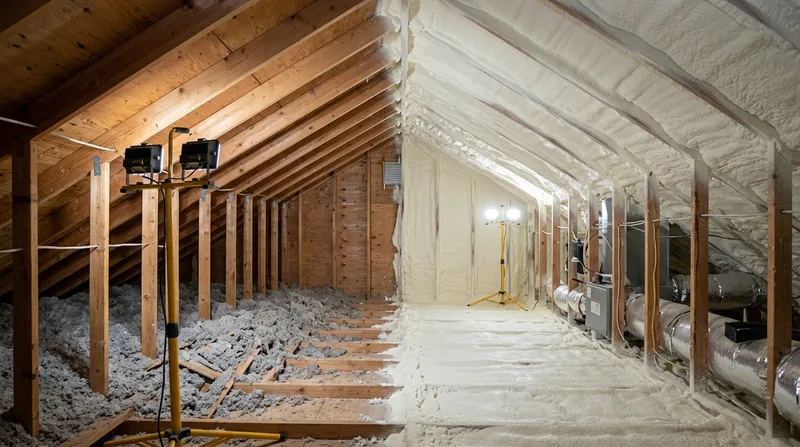




Kansas City's building stock tells the story of why insulation replacement and re-insulation matters here. From the brick-and-limestone shirtwaists of Hyde Park and Valentine to the 1950s ranches that blanket Raytown and the Northland, from the Tudor and Colonial homes of Brookside to the newer two-stories with bonus rooms over garages in Lee's Summit and Blue Springs, nearly every structure sits on a basement under an attic that bakes at 130 to 150 degrees Fahrenheit in July and freezes solid in January. Spring hail tears roofs open, new roofs go on, and when they do, the insulation underneath is often flattened, mouse-fouled, or soaked through. That is when a full reset makes sense: old material out, air sealed tight, new foam installed to current code. We have been doing this work since 2012, and it is the job that separates a real insulation shop from a one-afternoon spray crew.
Why Insulation Replacement Matters in Kansas City's Older and Mid-Century Homes
The Kansas City area is built on limestone bluffs where the Missouri and Kansas rivers meet, and that terrain means basements are universal. Attics, however, are where the climate does its damage. Flattened fiberglass batts lose their R-value the moment they compress under weight or moisture. Blown-in cellulose and fiberglass settle and gap over time. Older foam jobs without proper air sealing leave thermal bridges that bleed heat in winter and suck cool air out in summer. When a new roof goes on after hail damage, or when you open an attic and find mouse nesting in the insulation, or when you pull back drywall in a 1960s ranch and see the original batts soaked and molded, replacement is not optional. It is the reset that makes the rest of the envelope work.
- Remove all existing insulation, including any failed foam, flattened batts, or contaminated material that cannot be salvaged.
- Air seal every penetration, rim, joist, electrical outlet, and thermal bridge before new foam goes down.
- Install new closed cell or open cell spray foam to the R-value and thickness required by current code at your address.
- Verify thickness and coverage with a written estimate that specifies R-value, board feet, and pass thickness.
- Provide mechanical ventilation during cure and a clear re-entry window of 24 to 48 hours.
The right insulation replacement job leaves no gaps, no thermal bridges, and no guesswork about what is actually in the attic.
Key info: Kansas City's mixed-humid climate means vapor drive flips with the seasons: outward through cold winters, inward through humid summers. A proper replacement job addresses this with the right foam type and air sealing, not by hoping the old system will hold. Spring hail and new roofs drive most replacement jobs in this region.
For more on the removal process that precedes every replacement, see Insulation Removal.
How Insulation Replacement and Re-Insulation Works in Kansas City
The process starts with a hard look at what is already there. If the existing insulation is compacted, water-damaged, or contaminated, it comes out. If it is sound but undersized for current code, we may add foam over it. If the attic or crawl space has never been properly air sealed, sealing happens before new foam is sprayed. The goal is a complete thermal envelope with no thermal bridges, no air leaks, and clear documentation of what was done and why.
- Inspect the existing insulation and the substrate (roof decking, rim joists, basement band, crawl space walls) for moisture, mold, and structural soundness.
- Remove old material if it is flattened, contaminated, or undersized; leave sound insulation if it adds value to the new system.
- Air seal all penetrations, rim joists, band joists, electrical boxes, and rim-to-rim transitions with foam or caulk.
- Spray new closed cell or open cell foam to the specified thickness and R-value, measuring each pass to ensure coverage.
- Provide mechanical ventilation during application and cure, and confirm re-entry conditions before you occupy the space.
- Deliver a written estimate with R-value, thickness per pass, total board feet, and the warranty terms on workmanship.
This step-by-step approach is what distinguishes a full replacement from a quick top-up, and it is the difference between a stable envelope and a problem that will surface again in five years.
Real example: A 1950s brick ranch in Raytown had original fiberglass batts that had settled and compacted to R-8 in places. The homeowner added blown-in cellulose on top, which settled again. When we opened the attic, we found gaps around the rim, holes in the old batts where rodents had nested, and no air sealing at all. We removed everything, sealed the rim and all penetrations, sprayed 5.5 inches of closed cell foam for R-37, and installed a rim and band joist upgrade at the foundation. The attic temperature in summer dropped 12 degrees, and the ice dam problems stopped the next winter.
Learn more about air sealing and how it integrates with replacement work.
Insulation Replacement Methods and When to Use Each
| Approach | Description | Best for |
|---|---|---|
| Full removal and closed cell spray foam | Remove all existing insulation, air seal thoroughly, spray 5.5 to 6 inches of closed cell foam for R-37 to R-42 in attics or sealed roof decks. | New roofs, ice dam problems, crawl spaces with moisture, rim and band joists, attics that need a complete reset. |
| Full removal and open cell spray foam | Remove old material, air seal gaps, spray 8 to 9 inches of open cell foam for R-30 to R-33 in ventilated attics. | Budget-conscious attic replacements, ventilated attics where vapor permeability is an asset, sound dampening. |
| Partial removal and foam overlay | Remove contaminated or compacted insulation; leave sound material; air seal rim and joist penetrations; spray closed cell foam over the remaining base to reach target R-value. | Attics with some good insulation mixed with flattened areas, rim joist upgrades on sound basement insulation. |
| Removal with no replacement (crawl space prep) | Remove old batts or blown-in material and debris; air seal rim joists and band joists; prepare for closed cell foam application or leave as uninsulated but sealed. | Crawl spaces with standing water or high humidity that need moisture control before insulation; basement band joists that are the priority. |
The method you choose depends on the condition of what is already there, the current R-value code at your address, your budget, and whether the attic is ventilated or sealed. A site visit and a written estimate are the only way to know which is right for you.
Insulation Replacement and Re-Insulation Cost in Kansas City: What to Expect
Insulation replacement is priced by the board foot and the labor of removal, air sealing, and foam application. A typical attic replacement in Kansas City starts at $2,800 for a smaller attic (800 to 1,200 square feet) with straightforward access and no major contamination. Larger attics, crawl spaces, or jobs that require extensive air sealing or rim and band joist work run higher. The factors that move the price are attic size, access (knee walls, finished half-stories, and low clearance cost more labor), the condition of what is being removed, the R-value target at your address, and whether closed cell or open cell foam is specified.
A written estimate should include the board feet of foam, the thickness per pass, the R-value delivered, the removal scope, and the air sealing detail. If an estimate does not specify these items, ask for them. Comparing three estimates is standard; the lowest price often signals missing scope, no air sealing, or no documentation of what was actually installed.
For a detailed pricing breakdown and current rates for your specific job, see our pricing page or call (816) 307-2678 for a free estimate with written R-value and thickness specs.
Insulation Replacement and Re-Insulation Contractors Near Me: What to Verify Before You Hire
Kansas City and the surrounding area have both local independent spray foam shops and national franchise operations. The difference matters. A local contractor with a local address and local plates is answerable to the community and the building department where the work is done. A rig-and-run crew from out of state sprays a job in an afternoon, pockets the money, and vanishes when the smell will not go away or the thickness is wrong. Here is what to check before you sign an estimate.
- Ask for a written estimate that specifies R-value, foam thickness per pass, total board feet, and workmanship warranty terms.
- Verify that the contractor is fully insured and ask for a certificate of insurance naming your address as an additional insured during the work.
- Check that the estimate includes air sealing detail and removal scope, not just "spray foam application."
- Confirm the re-entry window: honest contractors specify 24 to 48 hours, not "immediate occupancy" or "no odor."
- Ask whether permits are required at your address and who handles the application; permitting rules vary by city across the Kansas City area, and there is no reciprocity between jurisdictions.
- Request references from recent jobs in your city (Kansas City, Independence, Lee's Summit, Blue Springs, Raytown, or wherever you are located) and call them.
- If your home is in an HOA with architectural rules, confirm that exterior work (metal building panels, new siding over foam) complies with those rules before you proceed.
A contractor who can answer these questions clearly, without hedging or pressure, is someone you can trust to do the job right and stand behind it afterward.
Ready to move forward? Contact us for a free estimate, or call (816) 307-2678 to discuss your specific situation.
Insulation Replacement & Re-Insulation in Kansas City: Pricing Guide
| Service | Price | Details |
|---|---|---|
| Attic replacement (800-1,200 sq ft) | Starting at $2,800 | Full removal, air sealing, closed cell foam to R-37, mechanical ventilation during cure included |
| Larger attic or crawl space (1,200-2,000 sq ft) | Starting at $4,200 | Removal, extensive air sealing, closed cell or open cell foam, rim and band joist upgrade if needed |
| Rim and band joist replacement | Starting at $1,200 | Removal of old insulation, air sealing, closed cell foam application to basement rim, labor and material |
| Complex or contaminated job | On estimate | Extensive removal, moisture remediation, multiple access challenges, or mixed removal and overlay require site inspection |
| Travel and logistics | Included | No mileage fee or travel charge within Kansas City and surrounding service areas, all costs in estimate |
| Free written estimate | No charge | Response within 24 hours, R-value and thickness specs included, no obligation to book the job |
Indicative pricing, the exact cost depends on square footage, finish, and site access. Free personalized estimate within 24h at (816) 307-2678.


