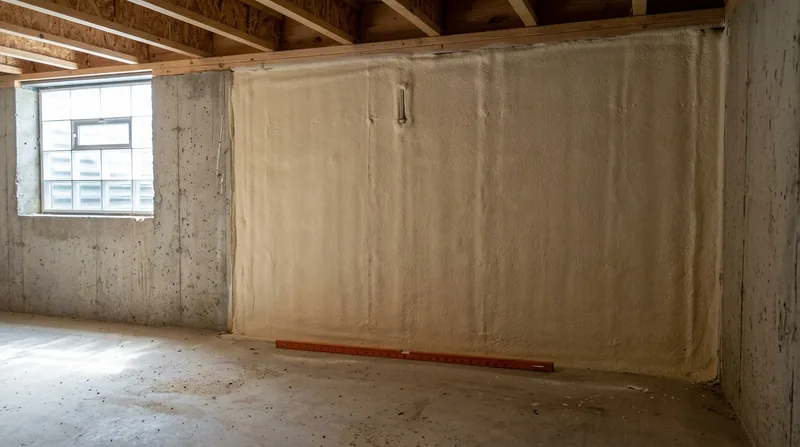




Closed cell spray foam insulation in Kansas City is the engineered answer to the vapor-drive problem that defines this region. Kansas City sits on limestone bluffs where the Missouri and Kansas rivers meet, and almost every home rests on a basement, the foundation that shapes every insulation decision. Summers push attic temperatures to 130 to 150 degrees Fahrenheit, while winters flip the moisture gradient inward through walls and rim joists. Two-pound closed-cell foam delivers R-6.5 per inch with its own vapor retarder, real structural stiffening, and the moisture control that matters when Kansas City's humidity swings from August saturation to January freeze-thaw cycling. Whether your brick bungalow in Brookside needs basement wall protection, your 1950s ranch in Raytown needs rim joist sealing, or your metal building in the Northland needs condensation control on steel, closed cell is the product engineered for Kansas City's climate and building stock. We have been installing spray foam insulation since 2012 and understand the exact failure modes that drive demand here. Learn more about our full range of spray foam and air sealing services.
Why Closed Cell Spray Foam Matters in Kansas City's Basement and Foundation Climate
Kansas City's topography and building tradition create a moisture problem that fiberglass and cellulose cannot solve. Nearly every home in the metro area sits on a basement sunk into limestone or clay, and the seasonal vapor drive that follows the temperature gradient means moisture travels outward in winter and inward in summer. Closed cell foam stops both directions because it carries its own vapor retarder, and at two pounds per cubic foot it also provides structural stiffening that matters when you are sealing rim joists or foundation walls that frame the house. The product is not a retrofit afterthought, it is the engineered solution for the climate and building envelope that actually exists here.
- We seal basement foundation walls with closed cell foam to stop moisture infiltration and thermal bridging through concrete block and stone.
- We spray rim joists and band joists where the house frame meets the foundation, the single biggest air leak in 1950s to 1980s Kansas City ranches and older Northland homes.
- We apply closed cell to metal building walls and roof decks where condensation forms on steel in spring and early summer.
- We inject closed cell into existing wall cavities of pre-1980 brick and frame houses without demolition, the retrofit that makes sense when the wall is sound but uninsulated.
- We use closed cell for sealed attic decks and cathedral ceilings where vapor control and structural support prevent sagging and ice dam cycles.
Each of these applications relies on closed cell's vapor retarder and its ability to handle the moisture swings that define Kansas City's mixed-humid climate.
Key info: Kansas City's spring and fall vapor reversals mean moisture can migrate in either direction. Closed cell foam's integrated vapor retarder stops both, which is why it is the standard choice for basements, rim joists, and metal buildings where condensation is the failure mode.
For more detail on how closed cell performs in Kansas City's specific climate, see our guide to air sealing and moisture control.
How We Install Closed Cell Spray Foam in Kansas City: The Process
Closed cell installation is a precision operation that begins with site preparation and ends with a stated re-entry window. We do not spray over wet, contaminated, or leaking substrates, and if moisture is present we fix it first or we walk away. The foam itself requires controlled drum temperature, the correct manufacturer ratio, and mechanical ventilation during application and cure. Our crew arrives with the rig, prepares the substrate, applies the foam in passes that respect the manufacturer thickness limits per application, and documents the final R-value and thickness in writing. You receive a written estimate before work begins that specifies the R-value and the thickness we will achieve, and you receive a completion report that confirms what was installed.
- We inspect the substrate, identify any moisture or contamination, and address it before foam touches the surface.
- We set up mechanical ventilation to manage off-gassing during application and the full cure window.
- We apply closed cell foam in controlled passes, respecting the two-inch-per-pass limit that ensures proper rise and density.
- We allow the foam to cure fully before re-entry, typically 24 to 48 hours depending on ambient temperature and humidity.
- We trim excess foam, install any required thermal barrier facing if the application is interior-facing, and clean the work area.
The entire process is documented so you know exactly what was installed and why it meets code for your address.
Local example: A 1960s brick ranch in Independence with an uninsulated rim joist and a basement that sweats in summer requires closed cell foam applied to the rim, the band joist, and the first course of block below grade. The job takes one day, the foam cures over 48 hours, and the result is a sealed thermal boundary that stops the moisture cycle and the air leakage that was driving heating and cooling loss.
For more on our comprehensive approach to insulation work, see our insulation removal and replacement services, which often precede a closed cell retrofit.
Closed Cell Spray Foam Installation Methods and Applications
| Application | Description | Best for Kansas City |
|---|---|---|
| Foundation Walls and Basements | Closed cell sprayed directly onto block, stone, or concrete foundation walls, typically 1.5 to 2 inches thick for R-10 to R-13 coverage. | Stops moisture infiltration and condensation in basements that sit on limestone or clay and experience seasonal vapor reversal. |
| Rim Joist and Band Joist Sealing | Closed cell applied to the rim board where the house frame meets the foundation, sealing the air gap and providing structural stiffening. | The single largest air leak in 1950s to 1980s Kansas City ranches, and the most cost-effective entry point for closed cell retrofit work. |
| Metal Building and Pole Barn Walls | Closed cell sprayed to the interior of metal roof decks and walls to control condensation on steel and provide R-value. | Barndominiums and metal shops in Cass, Clay, and Platte County that sweat in spring and frost inside in winter without vapor control. |
| Wall Cavity Injection and Retrofit | Closed cell injected into existing wall cavities of uninsulated or partially insulated pre-1980 brick and frame houses without removal of interior or exterior finish. | Two-and-a-half-story Kansas City shirtwaists and 1920s to 1940s bungalows in Hyde Park and Midtown where cavity walls are hollow and accessible from inside. |
| Sealed Attic Decks and Cathedral Ceilings | Closed cell sprayed to the underside of roof decking to create a sealed, conditioned attic with high R-value and structural support. | Knee walls and finished half-story attics in 1920s to 1940s Brookside and Country Club District homes that suffer ice dams and summer heat buildup. |
Closed Cell Spray Foam Insulation Cost in Kansas City: What to Expect
Closed cell spray foam in Kansas City typically starts at $1.20 per board foot and moves upward based on the thickness required, the difficulty of access, the substrate condition, and the size of the job. A rim joist and band joist sealing on a 1960s ranch might cost $1,500 to $3,000 depending on the linear footage and whether the basement is finished. A full foundation wall in a basement might run $2,500 to $5,000 depending on the square footage and the thickness specified. A metal building or pole barn wall scales with the cubic footage and the height, and can range from $3,000 to $10,000 or more. Wall cavity injection on a pre-1980 shirtwaist might cost $2,000 to $4,000 depending on how many cavities are accessible and how much foam is required to fill them.
The factors that move the cost are straightforward: the thickness of foam we apply (which determines the final R-value), the difficulty of access (basement stairs and tight crawl spaces cost more than open rim joists), the substrate condition (wet or contaminated basements require remediation first), and the scale of the job (small rim joist jobs have a higher per-board-foot rate than large foundation walls). Getting two to three estimates from contractors in your area is the only reliable way to understand what your specific job will cost, because every house is different and every estimate should be site-specific, not based on a price list.
We provide a written estimate at no cost and no obligation that specifies the R-value, the thickness, and the board footage we expect to install. For a detailed pricing overview and examples across different job types, see our full pricing guide.
Closed Cell Spray Foam Insulation Near Me: What Kansas City Homeowners Should Know When Hiring a Contractor
The spray foam industry includes both local independent shops and national franchises, and it also includes rig-and-run crews that arrive from out of state, spray a job in an afternoon, and vanish when the smell will not go away or the foam fails. The difference is not the logo on the truck, it is the behavior and the technique. A reputable closed cell contractor in Kansas City or anywhere else will provide a written estimate that specifies the R-value and the thickness before work begins, will document the substrate condition, will use mechanical ventilation during application and cure, will specify a re-entry window of 24 to 48 hours, and will provide a completion report. A contractor who offers an estimate with no R-value and no thickness, promises immediate re-entry, quotes a price far below market with no on-site inspection, or carries insurance that cannot be verified is a risk you should not take.
- Request a written estimate that specifies the R-value per inch, the total thickness, and the board footage, not just a price per square foot.
- Ask about the contractor's insurance coverage and request a certificate of insurance naming you as additional insured, then verify it with the carrier.
- Check references from recent jobs in Kansas City or your specific neighborhood, and ask about the smell and the cure timeline they experienced.
- Understand the permitting requirements for your address by calling your local building department, and ask the contractor how they handle permits and inspections.
- If your home is in an HOA or a historic district, verify that exterior work on metal buildings or additions meets architectural rules before you hire.
- Get two to three estimates and compare them on R-value and thickness, not just price, so you understand what you are buying.
The local independent contractor with a Kansas City address and local insurance is positioned against both the national franchise and the rig-and-run crew. Honest guidance is the differentiator: we will tell you when blown-in insulation is the right answer instead of closed cell, and we will walk away from a wet basement until the moisture is fixed. That is the standard you should expect from any contractor you hire.
Ready to get started? Contact us for a free estimate or call (816) 307-2678. We serve Kansas City and all surrounding areas, and we respond within 24 hours.
Closed Cell Spray Foam Insulation in Kansas City: Pricing Guide
| Service | Price | Details |
|---|---|---|
| Rim Joist and Band Joist Sealing | Starting at $1.20/board ft | Entry-point closed cell retrofit for 1950s-80s ranches, typically 200 to 500 linear feet of rim requiring 1.5 to 2 inch thickness |
| Foundation Wall Sealing (Basement) | Starting at $1.20/board ft | Full basement walls in stone, block, or concrete, 1.5 to 2 inches thick for moisture control, scales with linear footage and finished basement access |
| Wall Cavity Injection (Pre-1980 Retrofit) | Starting at $1.20/board ft | Closed cell injected into hollow cavities of uninsulated brick or frame walls without demolition, cost depends on cavity count and fill depth |
| Metal Building or Pole Barn Application | Starting at $1.20/board ft | Steel walls and roof decks for condensation control and R-value, cost scales with cubic footage and height, larger jobs typically lower per-board-foot rate |
| Sealed Attic Deck or Cathedral Ceiling | On estimate | Full roof deck sealing requires on-site measurement of square footage, access difficulty, and whether existing insulation must be removed first |
| Estimate and Travel | Free within service area | Written estimate with R-value and thickness specs, response within 24 hours, no obligation to book, travel included in Kansas City metro |
Indicative pricing, the exact cost depends on square footage, finish, and site access. Free personalized estimate within 24h at (816) 307-2678.


